
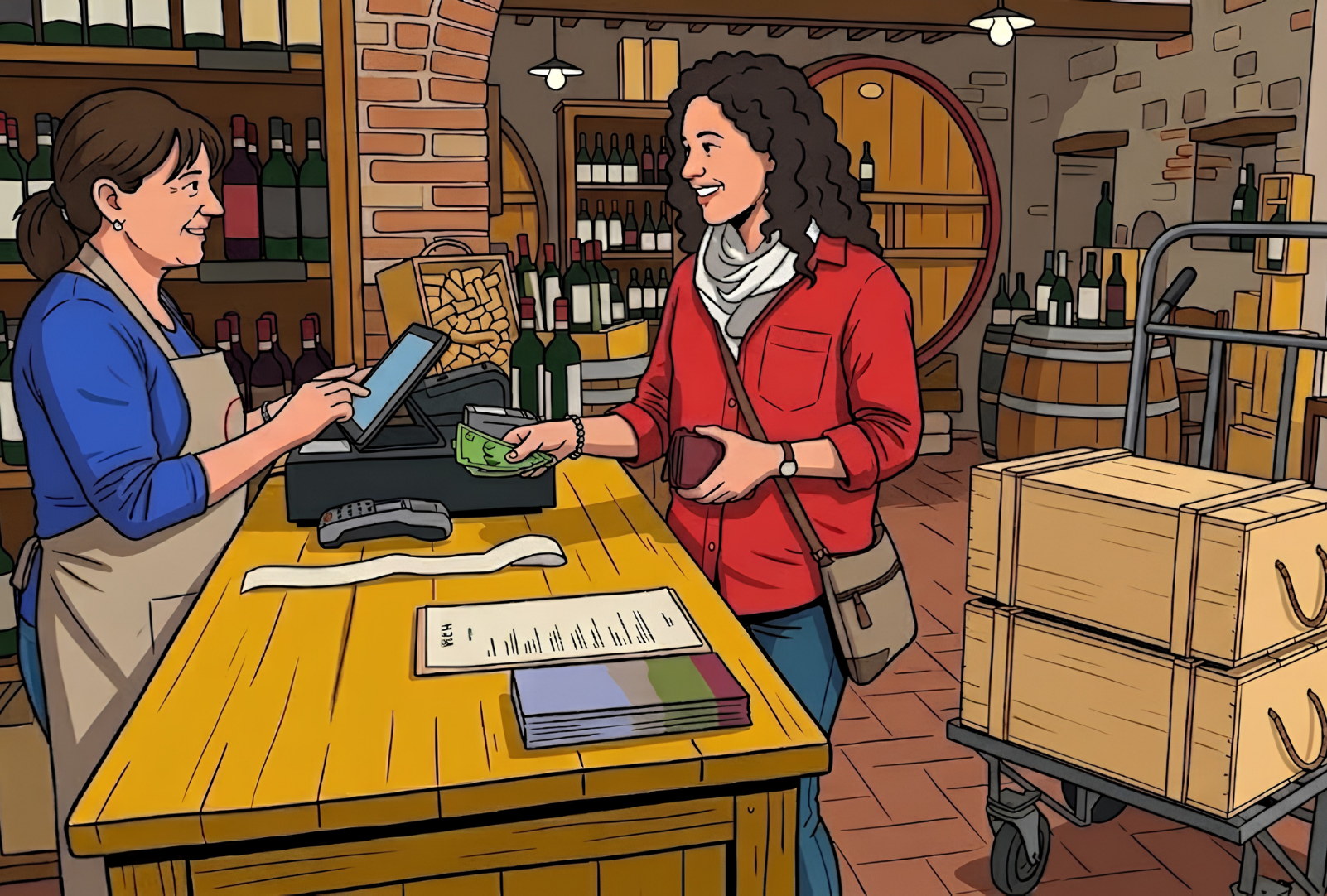
Managing wine sales to tourists represents a fundamental business opportunity for Italian wine tourism. Imagine a scene that plays out every day in a winery: a foreign tourist takes part in a tasting, buys a few bottles to take with them, and then asks to have additional cases shipped directly to their home abroad.
However, many producers fall into a widespread tax trap, believing that charging for shipping “separately” or having an external courier handle the delivery clears them of all responsibility. But the regulatory reality is quite different.
The "myth" of separate shipping fees
The most common incorrect practice in wine sales to tourists follows this scheme:
- A standard Italian receipt with Italian VAT is issued for the purchased bottles.
- The client is suggested a courier or provided with a dedicated POS (or a payment link) to settle the payment.
- It is simulated that the buyer organized the transport completely independently, attempting to bypass the requirement that shipping be handled by the supplier.
The goal of this trick is to formally shift the responsibility for managing transport onto the customer. However, this is an illusion that does not hold up during a tax audit.
Why 100% of the responsibility remains with the winery
European customs and tax regulations are extremely strict on this point. As clearly explained by Prof. Castagnetti, when the supplier gets involved—even indirectly—in managing or recommending the transport service, the legal nature of the transaction changes radically:
Since the wine physically leaves the winery, the transaction qualifies in every respect as a distance sale with indirect involvement of the supplier.
Consequently, two main obligations arise:
- VAT must be paid according to the rates and rules of the tourist’s country of residence (country of destination).
- Excise duties and the relative accompanying customs documentation must mandatorily be managed. Even in EU countries where the excise duty on wine is zero, the administrative procedure remains a legal obligation.
Sloppiness in cross-border sales: what are the risks?
As highlighted by Prof. Castagnetti in his presentation, many wineries approach selling wine to tourists with excessive sloppiness:
“The vast majority of wineries from this standpoint are careless when dealing with these issues, trusting that the excise duty is at zero. But the errors are there, and they are significant.”
Relying on sparse inspections or zero excise duties does not protect the winery from penalties. Improper management of the shipment turns an international sale into a tax and customs violation with heavy economic consequences for the winery.
How to manage shipments to foreign tourists safely
To continue selling wine to foreign tourists and shipping abroad without risking compliance issues with tax authorities, you need to follow a few key steps:
- Recognizing distance sales: If the goods leave the winery, you cannot mask it as an over-the-counter sale with a simple domestic receipt.
- Adjusting tax management: Structuring business processes to comply with cross-border VAT regulations and the management of excise duties and tariffs for EU and non-EU countries.
- Relying on specialized partners: Partnering with expert digital partners capable of handling customs procedures and relieving the winery of any risk.