
Some think that without a famous regional brand there is no hope of attracting visitors. But wine tourism attractiveness is not a geographical certificate: it is an activity born from your ability to add value to what you have right under your feet. From tastings on a campsite to stopovers for campervans among the vine rows, today’s demand rewards the originality of the experience, not just the fame of the area.
The territory is the raw material
Italy possesses a unique tourism capillary network where every single area has a story to tell. Success does not depend on the fame of the province, but on the ability to transform the winery into a destination.
Some have converted a simple plot of land into a Wine Camping oasis, proving that “place” is a strategic construct: if you offer a reason to stop, the tourist will come.
But attractiveness can stem from an aesthetic intuition or a new way of experiencing the land. Think of those who transform their courtyard into a pumpkin village in autumn or those who plant hectares of sunflowers just to offer that “Instagrammable” glance that pushes people to get in their car for a selfie and a glass of wine. It’s not just agriculture, it’s scenography applied to business.
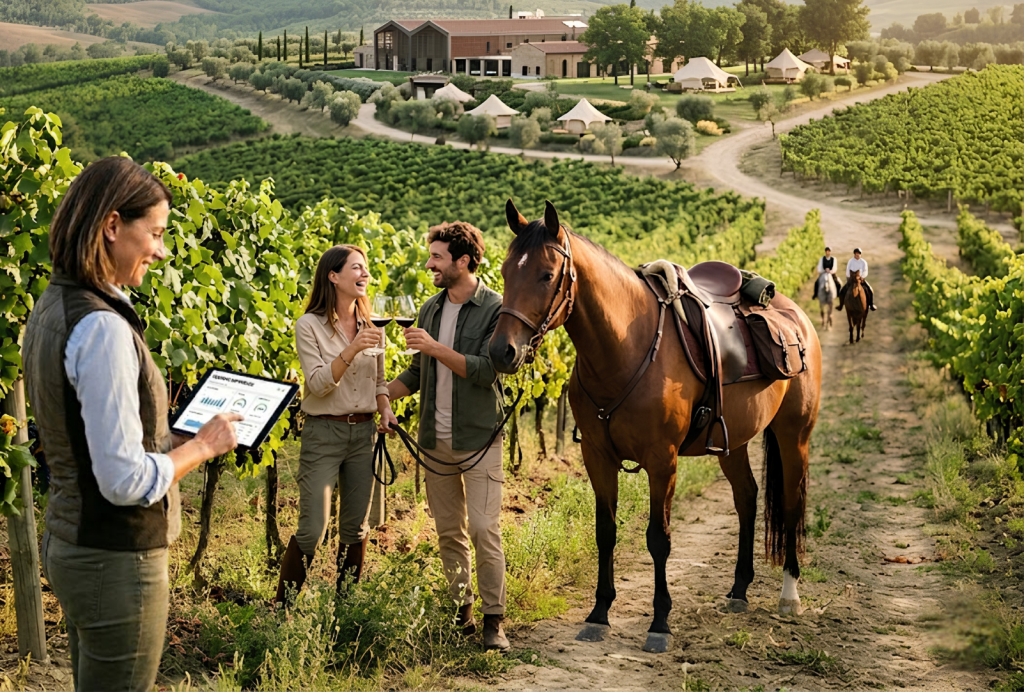
There are those who reinvent tastings by taking guests among the vine rows on horseback, and those who design night picnics where wine is just one part of a bigger story.
These companies aren’t just selling a bottle, they are selling the reason to detour from the main highway. The question to ask yourself is not “how famous is my area?”, but “what am I offering that cannot be found anywhere else?”.
The numbers of the new hospitality
The modern tourist shuns crowded circuits to seek authentic, off-the-beaten-path experiences.
The push for “off-the-beaten-path” travel is remarkably high: according to the Report on Italian Wine and Food Tourism by Roberta Garibaldi, 70% of travelers actively seek out lesser-known areas that are rich in identity.
The outdoor boom is equally evident. Freedom-based and slow tourism are the new pillars of regional promotion, as confirmed by recent ENIT analyses. .
Knowing macro-data and analyzing your own is one of the first steps to meeting the customer’s needs and sensing market demands, allowing you to fine-tune your hospitality strategies.
Generating your own wine tourism attractiveness
Stop looking at what is missing and starting to value what is already there is the secret to transforming a winery into a global asset. Once upon a time, people used to wait for the local tourism board to bring in visitors; today, the entrepreneur creates their own flow by communicating the uniqueness of their offer.
It is not the customer who has to guess why they should come to you: it is you who must give them a reason to detour from the main path.